Healthcare records may be accessible under either the Freedom of Information Act 2014 or Data Protection legislation, depending on the nature of the request.
Mercy University Hospital is committed to openness, transparency and protecting the privacy rights of patients, staff and members of the public.
Depending on the type of information you require, you may make a request under:
If you are seeking your own personal information or healthcare records, you should generally make a request under Data Protection legislation (GDPR/Data Protection Act 2018).
If you are seeking hospital administrative, governance, policy, or other non-personal records, you should generally make a request under the Freedom of Information Act 2014.
If you are seeking environmental information, you should make a request under the Access to Information on the Environment Regulations.
Access to information and records under Data Protection (GDPR)
Under the Data Protection Act 2018, you have the right to access personal data held about you.
What Personal Data Can You Access?
You may request access to:
- Your healthcare records.
- Personal identification details (e.g. name, address, date of birth).
- Clinical notes, test results and treatment history.
- Correspondence relating to your care.
- Any other personal data processed by the hospital.
You also have the right to request correction, erasure, restriction, or object to processing where applicable.
The hospital will respond to Data Protection requests within one month of receipt. Where a request is particularly complex or involves a large volume of records, this period may be extended by up to a further two months. You will be informed if an extension is required.
If you have a question before you send your request, phone 021 493 5538 or 021 493 7922.


General Data Protection Regulation (GDPR)
What is GDPR?
The General Data Protection Regulation (GDPR) came into force across the European Union on the 25th of May, 2018. It standardises and strengthens the right of all European citizens to data privacy. GDPR emphasises transparency, security and accountability for organisations that collect, use, share and store personal data. At the centre of the regulation is the requirement for organisations to be fully transparent about how they are using and safeguarding personal data and to be able to demonstrate accountability for their data processing activities.
Why is GDPR important?
Mercy University Hospital processes significant amounts of personal data and special category personal data relating to our patients, staff, students, and other individuals. People are increasingly aware of their rights and expect organisations to protect their personal data.
The GDPR places obligations and responsibilities on how the hospital collects, uses and protects personal data. At the centre of the regulation is the requirement for the hospital to be fully transparent about how we are using and safeguarding personal data and to be able to demonstrate accountability for data processing activities.
Scope of GDPR
The GDPR applies to the processing of personal data*. The definition of personal data however, specifically includes information such as identification (ID) numbers and internet protocol (IP) addresses that can be used to identify a person online. In practice, any data about a living person who can be identified from the data available (or potentially available) will count as personal data.
Stronger safeguards and requirements are required for sensitive personal data (referred to as ‘special categories of data’ under the GDPR). This refers to data falling under the following categories:
- Racial or ethnic origin
- Political opinions
- Religious or philosophical beliefs
- Trade union membership
- Data concerning health
- Data concerning a person’s sex life or sexual orientation
- Genetic data
- Biometric data.
Personal data falling under these categories can be processed only under specific circumstances which are described in Article 9(2) of the GDPR. Personal data is defined as:
“Any information relating to an identified or identifiable natural person (‘data subject’); an identifiable natural person is one who can be identified, directly or indirectly, in particular in reference to an identifier such as name, an identification number location data, an online identifier or to one or more factors specific to the physical, physiological, genetic, mental, economic, cultural or social identity of that natural person”.
What are the rights of individuals set out in GDPR?
The GDPR provides the following rights for individuals:
- The right to be informed
- The right of access
- The right to rectification
- The right to erasure/right to be forgotten (excluding medical records)
- The right to restrict processing in certain circumstances
- The right to data portability
- The right to object
- Rights in relation to automated decision making and profiling
The Data Protection Commissioner has a useful Guide to the Rights of Individuals under the General Data Protection Regulation (GDPR) available here.
Access for information and Records under Freedom of Information (FOI)
Under the Freedom of Information Act 2014 (Ireland), you have the right to:
Access records held by the hospital
Request correction of personal information that is inaccurate, incomplete, or misleading
Obtain reasons for decisions made by the hospital that affect you
Records Covered Under FOI
FOI applies to records held by public bodies, including hospitals. These may include:
- Administrative and operational records.
- Policies, procedures and guidelines.
- Financial and governance records.
- Correspondence relating to your care or interactions with the hospital.
- Certain healthcare records.
Records Exempt from FOI
Some records may not be released under FOI. These include:
- Personal information relating to another individual.
- Information given in confidence.
- Records that could impact patient safety or wellbeing.
- Records subject to legal privilege.
- Sensitive operational or security-related information.
- Records relating to ongoing investigations or proceedings.
- Commercially sensitive information.
- Information affecting negotiations of public bodies.
How to submit a request
- Complete the relevant request form.
- Submit your request in writing to foi@muh.ie or by post to Freedom of Information Department, Quality and Risk Management, Mercy University Hospital, Grenville Place, Cork.
- Provide sufficient detail to identify the records required.
Proof of identity is required before personal information can be released. This may include a copy of a passport, driving licence, etc. containing handwritten signature. Additional proof of address may be requested where necessary.
Use this form to request your own healthcare records under Data Protection legislation or the Freedom of Information Act 2014. Proof of identity with a…
Request for Access to Medical Records — Patient
Resources
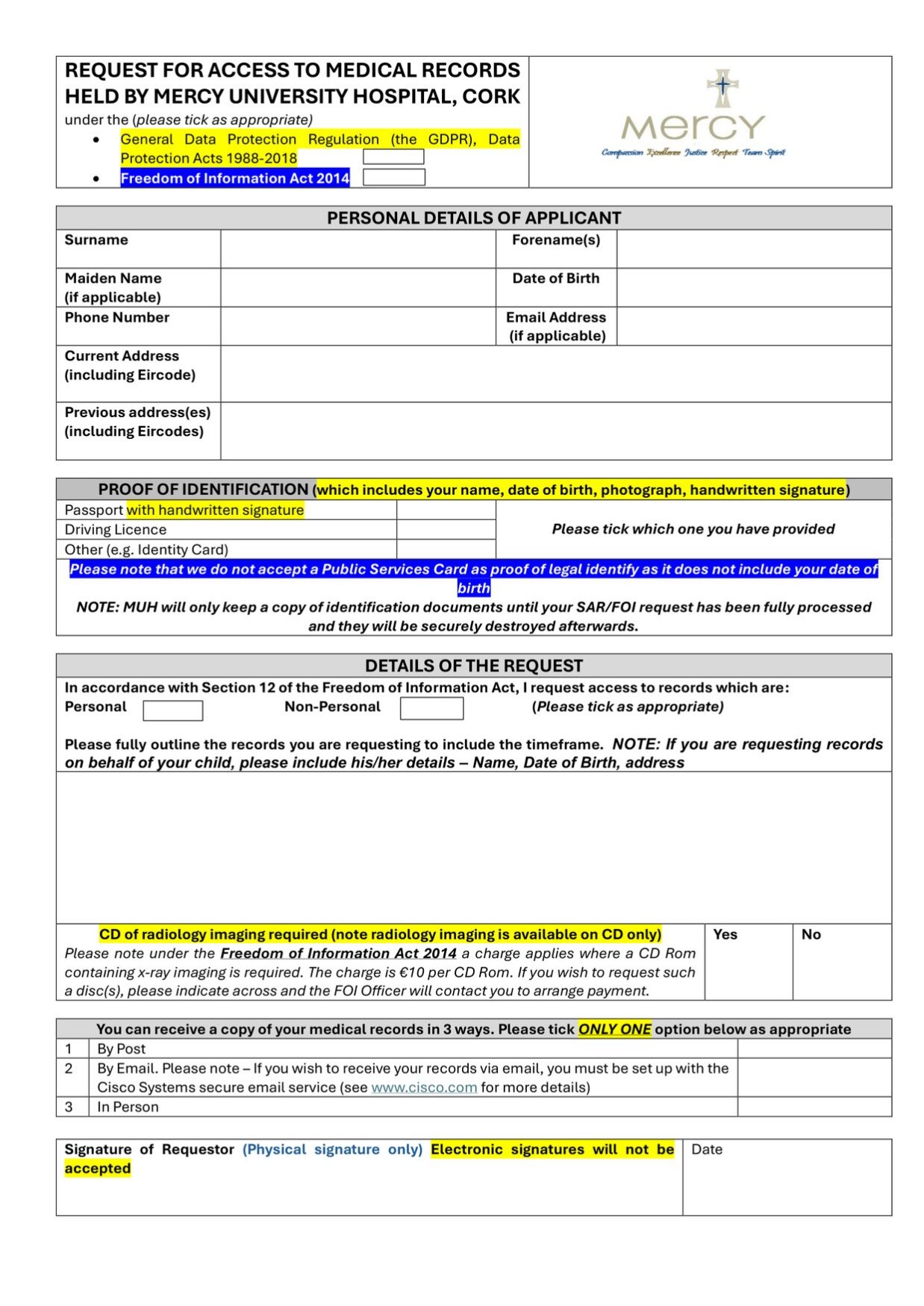
Use this form to request your own healthcare records under Data Protection legislation or the Freedom of Information Act 2014. Proof of identity with a handwritten signature is required — a Public Services Card is not accepted.
Use this form to request the records of a person who has died, under the Freedom of Information Act 2014. You must be entitled to…
Request for Access to Medical Records — Deceased Person
Resources
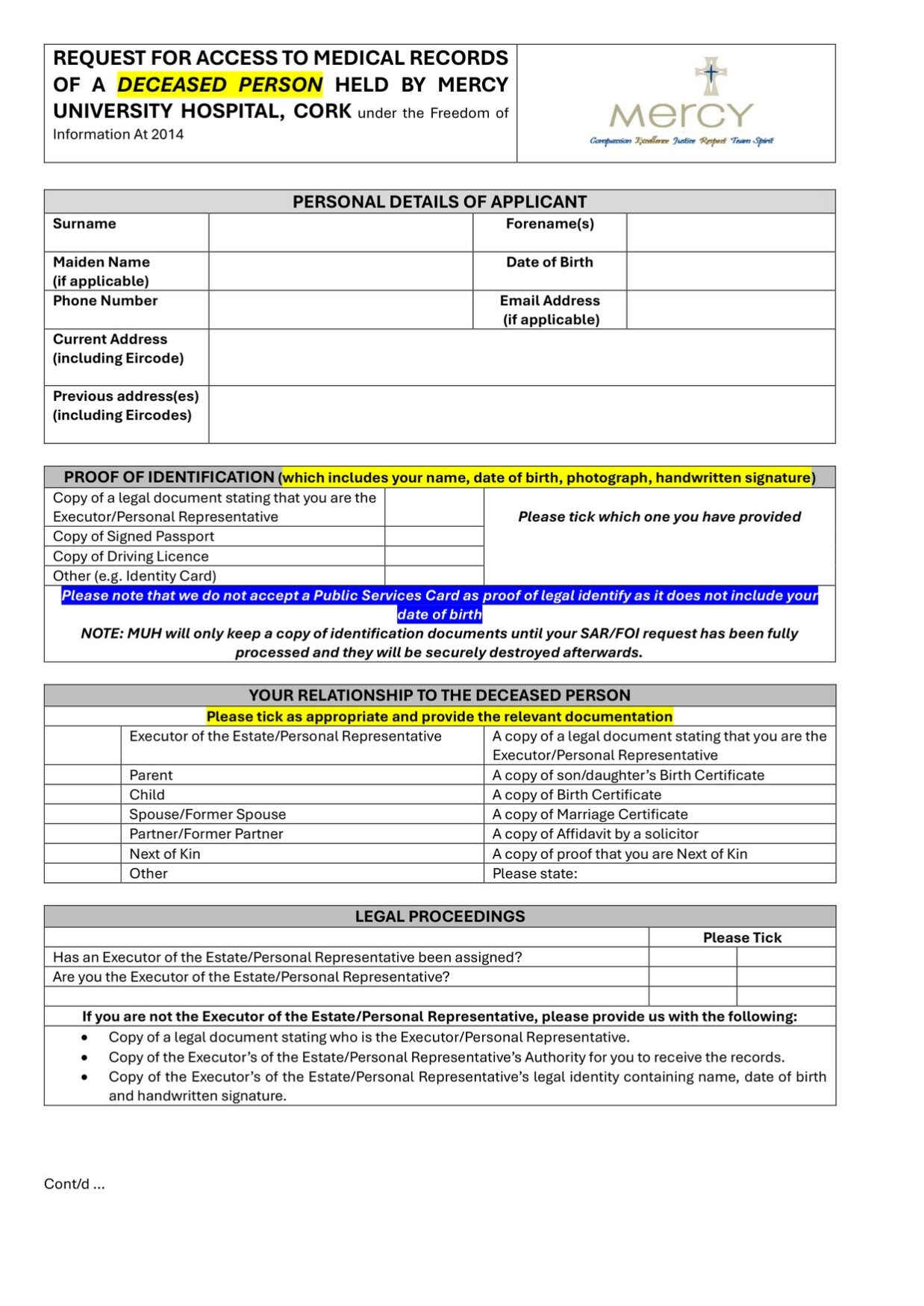
Use this form to request the records of a person who has died, under the Freedom of Information Act 2014. You must be entitled to apply, and a Death Certificate or Certificate of Fact of Death is required along with photographic ID. November 2025 version.
More about requests
Requesting records relating to a deceased person
Under Irish law, access to records of a deceased person is restricted.
Access to the records of a deceased person may be granted only in specific circumstances permitted by law. Applicants may be required to demonstrate their relationship to the deceased and/or their legal authority to act on behalf of the estate. Each request will be considered on its own merits and in accordance with applicable legislation.
You must demonstrate that you are one of the following:
- Executor or administrator of the estate.
- Personal representative.
- Spouse or former spouse.
- Parent or guardian.
- Child of the deceased.
- Next of kin.
If you meet one of the above criteria, please complete the relevant request form.
Download the form: Request for Access to Medical Records — Deceased Person
NOTE: copy of Death Cert/Certificate of Fact of Death and photographic ID is required containing handwritten Signature to access any personal information and/or records.
Confidentiality
All personal and medical information is treated with the utmost confidentiality.
- Information is stored securely.
- All staff are bound by confidentiality obligations.
- Identity verification is required before release.
- Additional checks may be carried out where necessary.
Will all requested information be released?
While you have a right to access your information, not all records may be released in full.
A decision-maker will review each request. Information may be withheld or redacted where:
- It contains personal data relating to another individual.
- It was provided in confidence.
- Disclosure could cause serious harm.
- It could prejudice legal proceedings.
- It is legally privileged.
- It relates to investigations or law enforcement.
- It may impact safety or hospital operations.
What if my records are incomplete or incorrect?
Under the Data Protection Act 2018, you may request:
- Correction of inaccurate or incomplete information
- Deletion of data (where applicable)
- Restriction of processing
Please contact the Data Protection Office at gdpr@muh.ie if you wish to submit a request to amend your records.
NOTE: You may be asked to provide supporting evidence.
Is there a fee?
There is no fee for submitting a request under the Freedom of Information Act 2014.
In most cases, there is no charge for accessing records relating to your personal information. However, where a request involves a significant volume of records or substantial search, retrieval and copying work, charges may apply in accordance with the Freedom of Information Act 2014 and associated regulations. Search, retrieval and copying charges may apply to non-personal requests in accordance with the Freedom of Information Act 2014 and associated regulations.
Schedule of Fees
- Search and retrieval: €20 per hour.
- Photocopying: €0.04 per page.
- Internal Review application: €30 (€10 for medical card holders).
- Appeal to the Office of the Information Commissioner: €50 (€15 for medical card holders).
Where the cost of search, retrieval and copying is:
- Less than €101 – no charge applies.
- Between €101 – €500 Below listed schedule of fees applies:
- Search and retrieval: €20 per hour
- Photocopying: €0.04 per page
- Internal Review application: €30 (€10 for medical card holders)
- Appeal to the Office of the Information Commissioner: €50 (€15 for medical card holders)
- Greater than €500 but less than €700 – a maximum charge of €500 applies.
- Greater than €700 – the hospital may refuse to process the request unless it is refined to reduce the estimated cost below that amount.
Important Notes
- There is generally no charge where records contain only the applicant’s personal information, unless the request involves a significant number of records.
- The hospital will notify you in advance if any fees or deposits are likely to apply
- A full schedule of fees is available on request
Data Subject Access Requests made under Data Protection legislation are generally free of charge. However, the hospital may charge a reasonable fee or refuse to act on a request where it is manifestly unfounded, excessive, or repetitive, as permitted under the GDPR.
How long will it take?
Requests are normally acknowledged within 10 working days of receipt. A decision on your request will generally issue within 20 working days, in accordance with the Freedom of Information Act 2014.
You will be notified if delays occur. Extensions may apply where necessary.
What if I am not satisfied with the decision on my FOI request?
You may appeal the decision issued by MUH in writing to foi@muh.ie, or to The Internal Reviewer, Freedom of Information, Mercy University Hospital, Grenville Place, Cork, T12 WE28.
Applications for Internal Review should normally be made within four weeks of the date of the decision.
Your request should state that you are seeking an Internal Review of the matter. A fee of €30 (€10 for medical card holders) may apply for such an appeal. There is no fee for internal review applications concerning only personal information or in relation to a decision to impose a fee or deposit.
You should make your appeal within four weeks from the date of response (although late appeals may be permitted in certain circumstances). The appeal will involve a complete reconsideration of the matter by a more senior member of staff of the hospital, and a decision will be communicated to you within three weeks.
What if I am not satisfied with the decision of internal review?
You may appeal within six months by writing to the Office of the Information Commissioner, 6 Earlsfort Terrace, Dublin 2, D02 W773.
Phone 01 639 5689, email info@oic.ie.
A fee of €50 (€15 for medical card holders) may apply for such an application. There is no fee for appeals to the Office of the Information Commissioner concerning only personal information or in relation to a decision to impose a fee or deposit.
Access to Information on the Environment (AIE)
Under the Access to Information on the Environment (AIE) Regulations 2007–2018, members of the public have the right to access information on the environment held by Mercy University Hospital, Cork.
Environmental information includes data on the state of the environment, factors affecting it (such as emissions, energy, or waste), and measures or activities impacting the environment.
Requests for environmental information can be made in writing or by email and should state that the request is being made under the AIE Regulations. Requests should be as specific as possible.
AIE Requests should be submitted to:
Email: foi@muh.ie
Phone: 021 424 8161
Post: FOI, Mercy University Hospital, Cork, Grenville Place, Cork, T12 WE28
A response will normally be issued within one month, in accordance with the Regulations. Fees may apply in certain circumstances, such as for copying or extensive retrieval of records.
Further information on AIE is available here.


Publication Scheme
The Freedom of Information Act 2014 requires public bodies to make information available to the public as part of a Publication Scheme.
The Mercy University Hospital Publication Scheme is intended to promote openness and transparency by providing information about:
- The structure and functions of the hospital.
- Services provided to the public.
- Policies, procedures and guidelines.
- Governance and organisational information.
- Financial and procurement information.
- Reports, strategies and plans.
- Information relating to how decisions are made.
Information published under the Publication Scheme can be accessed without making a formal Freedom of Information request.
Where the information you require is not available through our website or Publication Scheme, you may submit a request under the Freedom of Information Act 2014.
NOTE: Before submitting a Freedom of Information request, please check our Publication Scheme and information available on our website, as the information you require may already be publicly available.


More Patients Info
Patient information for Mercy University Hospital — appointments, your hospital stay, support services and your rights as a patient.

Details on hospital fees, statutory charges, and private and semi-private accommodation rates at Mercy University Hospital.

Mercy University Hospital is committed to providing safe, effective, person-centred healthcare in an environment that is safe for patients, staff and visitors.

What to expect during your stay at Mercy University Hospital — admission, ward life, meals, visiting hours and discharge.

Compassionate, dignified end of life care for patients and families at Mercy University Hospital.

Information on accessing your medical records, Freedom of Information requests and patient data rights at Mercy University Hospital.
The forms, what it costs, how long it takes, and how to appeal a decision.

We Value Your Feedback